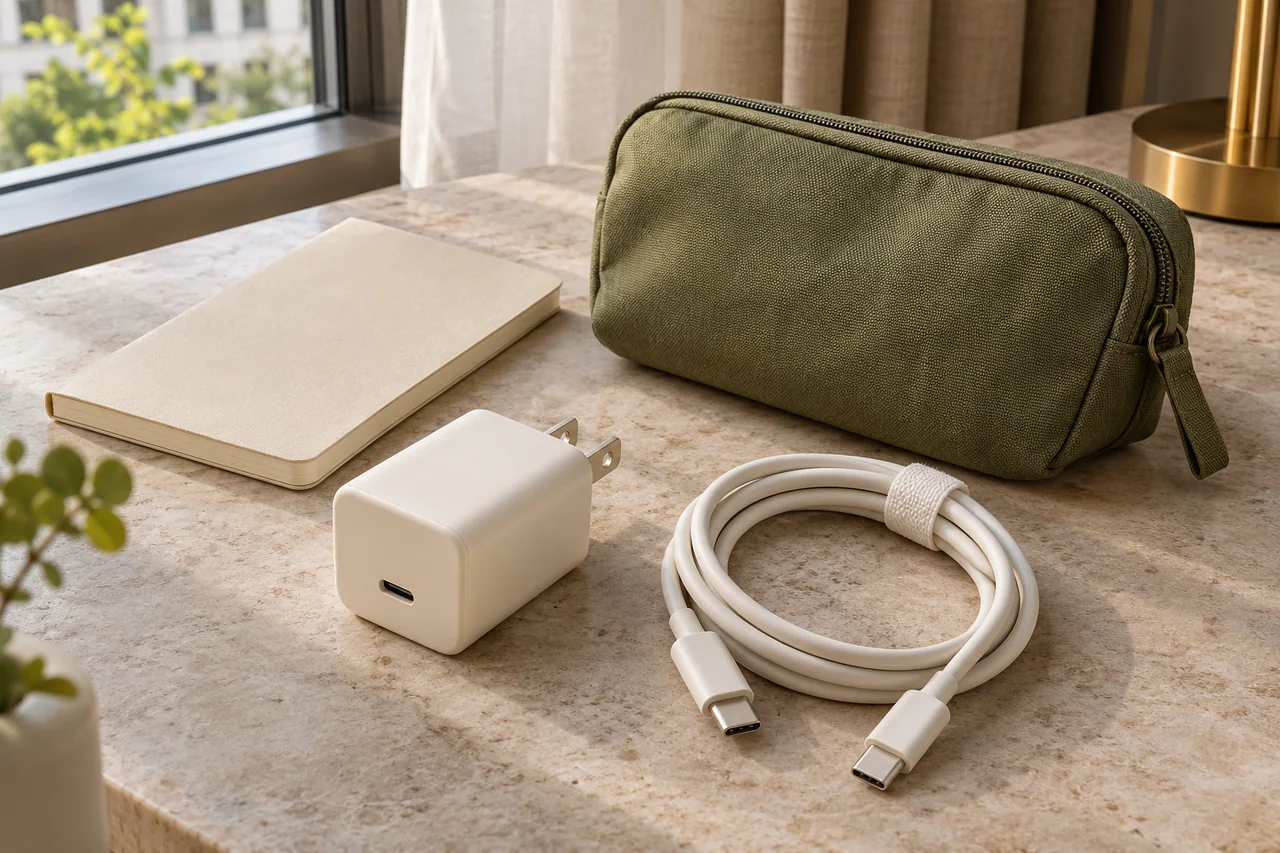
A dependable travel charging kit starts with an inventory of devices and a realistic picture of when you will charge them. A large wattage printed on a box is only one part of that decision. The useful question is whether your charger, cable, and device work together in the arrangement you expect to use away from home.
This guide explains a buying process rather than recommending unverified products. It covers ordinary personal electronics such as a phone, laptop, and headphones. Equipment with specialist charging requirements needs its own manufacturer instructions. Build the kit on paper first, test it at home, and keep only the accessories that perform a defined job.
Create a device and port map
List each device, its charging connector, its manufacturer-recommended charging arrangement, and whether it needs a dedicated accessory. A watch with a proprietary charging puck belongs on the list even if most of your other devices use USB-C. Note which devices you actually need to charge simultaneously and which can take turns overnight.
For example, a laptop and phone used throughout the working day may need two available outputs in the evening, while headphones can charge later. That schedule could change the charger you buy. The map also exposes a forgotten cable before departure and helps you avoid buying an organizer large enough to conceal an unnecessarily complicated setup.
Read the shared-power arrangement
For a multiport charger, look for the manufacturer table showing output with each combination of ports occupied. Compare the output available to your laptop in that arrangement with the laptop guidance. Check whether connecting another device changes the distribution. A total figure alone does not tell you what each port will deliver when several are in use.
As a planning example, a desired 65-watt laptop output plus a 20-watt phone output adds up to 85 watts. That arithmetic is a requirement to investigate, not proof that any charger with an 85-watt or larger label will provide that exact combination. Verify the relevant modes, port allocation, and compatibility in the product documentation.
Choose cables for the job they perform
USB-IF explains that cables have different capabilities and should be selected for the intended use. Check the cable power rating as well as the connectors at both ends. If you also need to connect a monitor or transfer large files, verify those capabilities separately; the connector shape is not a complete specification.
Choose cable lengths according to your likely setup. A short lead can be convenient inside a power pouch, while a longer one may suit a hotel desk. Carry one deliberate backup for the device that matters most. Label similar cables if they have different jobs, and replace a damaged one before building the trip around it.
Check the destination connection
Read the charger input label and confirm the plug arrangement for the destination. Keep the exact product instructions with your planning notes. Apple, for example, states that its World Travel Adapter Kit changes plug shape rather than voltage and is designed for compatible genuine Apple power adapters. Apply manufacturer-specific guidance to the equipment you actually own.
A universal-looking accessory can still have limitations. Check which plugs are included, how the parts connect, and whether the assembled setup will be practical to carry. If you need several countries on one trip, take only the verified pieces for those stops. Do not extend a phone-charger arrangement to a high-power appliance without checking that appliance and adapter explicitly.
Decide whether a power bank solves a real gap
Think about the longest period you expect to be away from an outlet and the devices you need during it. That identifies the role for a power bank more clearly than choosing the largest capacity available. Look for a readable watt-hour marking, the output needed by your device, and the full weight of the unit with its cable.
For U.S. air travel, the FAA requires power banks in cabin baggage with terminals protected. Its ordinary lithium-ion limit is 100 Wh; larger batteries have separate approval conditions. Airlines can apply stricter limits, so verify your carrier, including onboard use and charging rules. Remove the power bank if your cabin bag is taken for checking.
Test the whole setup before packing
Connect the devices in the combination you plan to use and confirm that each behaves as expected. Repeat the test with your chosen travel cables, rather than the ones that happen to be on the desk. Check that the intended plug accessories fit the compatible charger and that you know which piece goes with which device.
Finish by putting the kit into its pouch and taking it out once. The pouch should make the pieces visible and easy to count. A short contents list helps at checkout: charger, destination plug, laptop cable, phone cable, and any dedicated accessory. Update it only when your devices or itinerary change, and avoid turning every trip into a new charging experiment.
KEEP IT SIMPLE
Your quick checklist
- Device charging requirements recorded
- Multiport output table checked
- Each cable matched to its intended job
- Destination plugs and charger input checked
- Power-bank watt-hour marking checked
- Operating carrier battery rules checked
- Power bank ready to remove for gate checking
- Intended devices charged together
- Full kit packed into one pouch
- Contents list saved for checkout
FURTHER READING
Sources & useful references
These sources support the guide. Rules and product details can change; check the relevant provider before your trip.
- USB-IF: cable capabilities and certificationChecked November 16, 2026
- Apple Support: using the World Travel Adapter KitChecked November 16, 2026
- FAA PackSafe: lithium batteries and power banksChecked November 16, 2026
Our guides are based on source research and practical comparisons. We identify hands-on testing when it has actually taken place. Some commercial links may earn a commission.
How our recommendations and links work