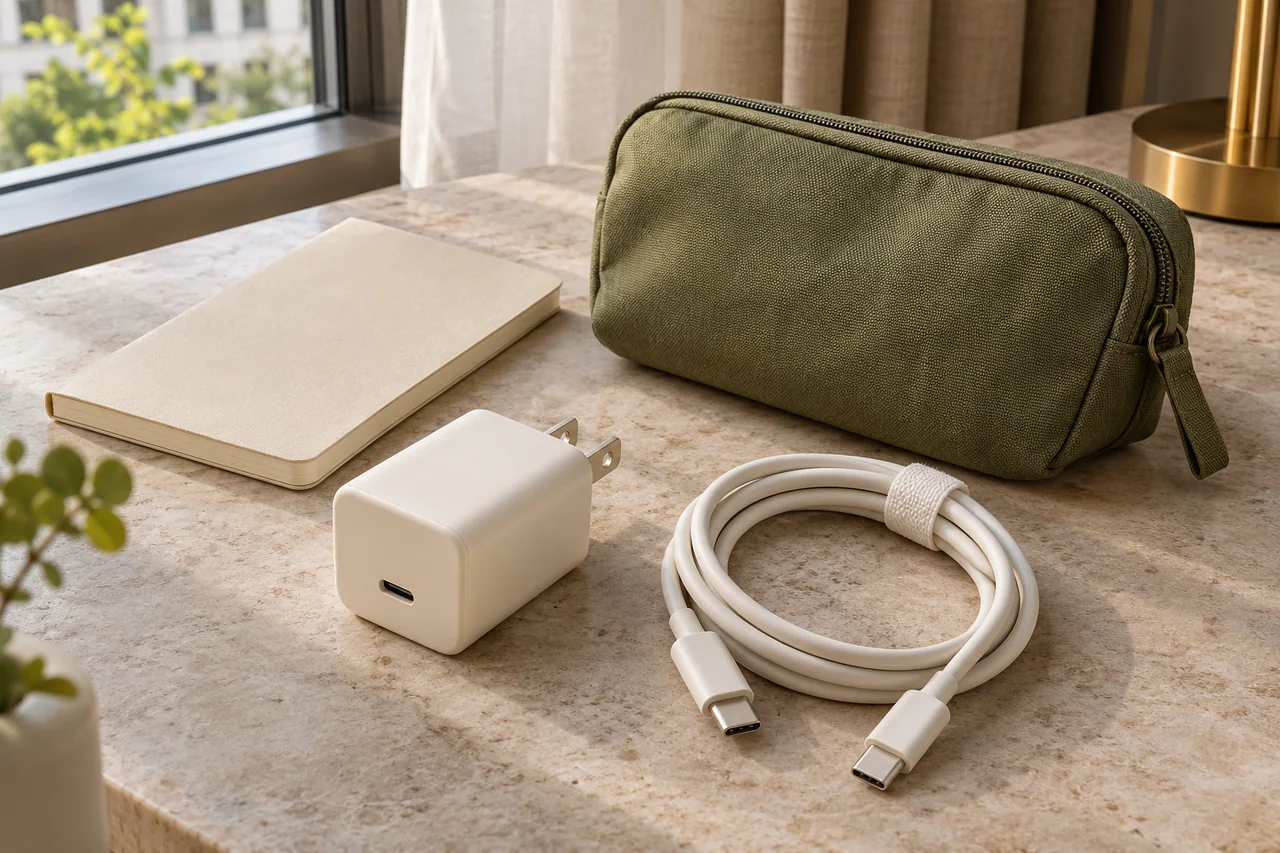
An unfamiliar wall socket is only the visible part of an international charging problem. The plug shape, the voltage and frequency supplied by the building, the requirements of your charger, and the adapter’s current rating all matter. Solving only the shape problem can leave a device electrically incompatible with the outlet.
A travel plug adapter changes the physical connection. It does not normally transform the supply voltage or frequency. A destination-specific plug or the removable plug supplied by a device manufacturer may be simpler when all your equipment already supports the local electrical supply. Neither arrangement should be treated as proof that a single-voltage appliance is safe abroad.
Use this guide as a pre-departure checklist for your own devices and destinations. It deliberately does not rank untested products, recommend a particular affiliate listing, or promise that a multi-country adapter works safely in every outlet.
1. Read the input label before choosing a plug
Start with the power supply or appliance you will actually plug into the wall, not the phone or laptop it happens to charge. Find its INPUT rating, usually printed in very small type on the charger brick, power supply or appliance. A label such as “100–240 V AC, 50/60 Hz” indicates a wide input range; check both the voltage and frequency against your destination. Different devices in the same bag can have different input ratings.
If a device is marked only for a narrow voltage range, do not assume a plug adapter makes it suitable for another mains system. Some high-power hair tools and heating appliances require particular voltage arrangements; their manufacturers’ instructions take precedence. A converter or transformer is a different device, and selecting one requires an electrical-load and compatibility check, not just a plug-shape match.
Apple explains that its removable travel plug pieces alter pin shape while the associated power adapters are specified for 100–240 V AC and 50–60 Hz. That is useful as an example of checking a manufacturer-specific combination, not permission to attach an Apple plug piece to an unrelated power supply.
- Record the exact INPUT voltage and frequency from each wall-powered device.
- Separate multi-voltage charging bricks from single-voltage appliances.
- If the label is missing or unclear, ask the manufacturer before connecting it abroad.
2. Check the destination socket and the earth connection
Next identify the socket used where you will stay and the type of plug that your charger already has. Countries and even particular accommodations can differ, and a transit hotel or cruise cabin should not be assumed to use the outlet at your final destination. Consult the destination or accommodation details close to departure. A country code on a retail listing is not a guarantee that an adapter fits every installation.
A compact country-specific plug can be a good fit when you need one destination and only a few low-power devices. A multi-region adapter can reduce the number of pieces for an itinerary with several socket types, but the complexity brings extra checks: available pin configurations, locking mechanism, input and output limits, and whether its sockets genuinely preserve an earth connection.
Electrical Safety First warns that some travel adapters cannot be used with equipment requiring an earth connection and are suitable only for double-insulated appliances. Do not confuse a three-hole socket face with verified grounding. Check the instructions for both the device and the exact adapter, and never defeat an earth pin or force a plug into a mismatched outlet.
- Confirm the expected socket type for every stop, including transit nights.
- Check if the appliance requires protective earthing or is marked Class II/double-insulated.
- Use only plug types and configurations explicitly permitted by the adapter manufacturer.
3. Look at the adapter rating, not the marketing wattage
An adapter’s socket rating and its built-in USB charging rating are different limits. A product advertised with a high combined USB wattage does not necessarily deliver that power from a single USB-C port or while every port is occupied. Read the exact port-combination table if you want to charge a laptop and phone together, and verify cable requirements separately.
For a mains pass-through socket, compare the adapter’s stated maximum current or power with the appliance’s input requirement and the local supply. Avoid daisy-chaining adapters, plugging a travel adapter into an extension lead, or overloading a single socket. A worn, loose or damaged unit should not be used even if its printed specification appears suitable.
Ireland’s Competition and Consumer Protection Commission advises that travel adapters are for short-term use, should not be overloaded, and should be unplugged when no longer needed, when leaving accommodation and before sleeping. Its recall guidance is another reason to verify the exact model and retail source rather than relying on marketplace stars or a broad “universal” promise.
- Check the adapter socket’s current/power rating and the product’s instructions.
- For a charger with USB ports, check per-port and simultaneous-port outputs.
- Inspect for damage, avoid overloaded or improvised chains, and check current safety recalls.
4. Choose the minimum equipment that meets your itinerary
If your existing charger is genuinely multi-voltage and your trip has one known outlet type, an approved country-specific plug arrangement may be enough. If you must serve several socket types, compare a properly specified multi-region adapter with a small set of destination plugs. Choose by your device list, grounding needs, expected outlets and travel duration, rather than by the number of countries printed on the packaging.
If one appliance is incompatible with the local voltage, set it aside while resolving that specific issue. For items such as hair dryers, an accommodation-provided device or a manufacturer-approved travel model can be less complicated than carrying an uncertain converter. Before departure, photograph the input label, test that all plug pieces lock as instructed without connecting to an incompatible supply, and keep the manufacturer’s manual available.
For the rest of your charging setup, see our travel charging kit guide. If you are also flying with a separate power bank, check the airline and aviation-authority battery rules independently: those rules concern the battery, not the wall adapter.
- One destination: prioritize a documented matching plug and known device ratings.
- Several destinations: verify each mechanical plug configuration and electrical limit.
- Uncertain equipment: do not connect it until the manufacturer confirms suitability.
FURTHER READING
Sources & useful references
These sources support the guide. Rules and product details can change; check the relevant provider before your trip.
- Electrical Safety First — official guidanceChecked November 18, 2026
- Ireland CCPC — official guidanceChecked November 18, 2026
- Apple Support — official guidanceChecked November 18, 2026
Our guides are based on source research and practical comparisons. We identify hands-on testing when it has actually taken place. Some commercial links may earn a commission.
How our recommendations and links work