A power bank is useful only if you can bring it on your particular flight and use it in the way you expect. The largest advertised capacity is not automatically the most practical purchase. You need to understand the battery's watt-hour rating, where it must be packed, and the operating airline's current instructions.
International rules changed in March 2026, and older packing advice may not describe the same limits. This guide explains what to check before departure. It is a policy-and-label reading guide, not a ranking or a hands-on test of individual batteries. Always use the current rules for your carrier, route and device.
Start with watt-hours, not just milliamp-hours
Capacity labels often emphasize milliamp-hours (mAh), but airline battery restrictions use watt-hours (Wh). The values are related, not interchangeable. Where the manufacturer gives the battery's nominal voltage and capacity, multiply volts by amp-hours to calculate watt-hours; divide mAh by 1,000 to obtain Ah first. Do not substitute the USB output voltage for the cell voltage without manufacturer documentation.
As a simple arithmetic example, 20,000 mAh at a documented nominal 3.7 V equals approximately 74 Wh. The number is only an illustration, not a verification of any particular model. Check the Wh value printed on the physical battery or in its official product manual, and confirm that the marking identifies the exact unit you intend to carry. A seller's headline capacity alone is not adequate evidence.
- Record the exact model and its stated Wh rating.
- Keep a readable photo of the original battery label or product specification.
- Treat a missing or ambiguous capacity marking as a reason to check with the airline, not a reason to guess.
Understand the March 2026 two-power-bank change
The International Civil Aviation Organization announced new specifications effective 27 March 2026: passengers are limited to two power banks for personal use and may not recharge a power bank during a flight. These requirements address portable power banks specifically; they should not be confused with broader categories of installed device batteries or loose spare batteries.
Do not read the ICAO limit as a guarantee that two power banks will be accepted on every flight. Individual airlines may restrict the quantity further, require batteries to remain accessible, or prohibit using a power bank to charge another device in flight. The ICAO announcement distinguishes recharging the bank itself from charging a phone; your airline may restrict both. Confirm the actual operating carrier's latest policy rather than relying on an older general travel checklist.
Check the watt-hour limits for your journey
FAA passenger guidance for U.S. flights describes a typical lithium-ion limit of 100 Wh per spare battery. The FAA also describes an approval process for certain larger spare batteries in the 101–160 Wh range, with a maximum of two larger spares per person. This is a U.S. regulatory starting point, not blanket permission to carry a 160 Wh power bank on every international route.
Check whether the airline accepts the power bank category and capacity you have, not merely whether the underlying battery might qualify for an exception. ICAO's newer power-bank specifications and carrier-specific limits can be more restrictive than the general wording on an older FAA page. Batteries over 160 Wh do not belong in a normal passenger power-bank packing plan. Road-trip or camping power stations should not be presented as ordinary flight-ready phone chargers.
Pack the bank in the cabin and protect it
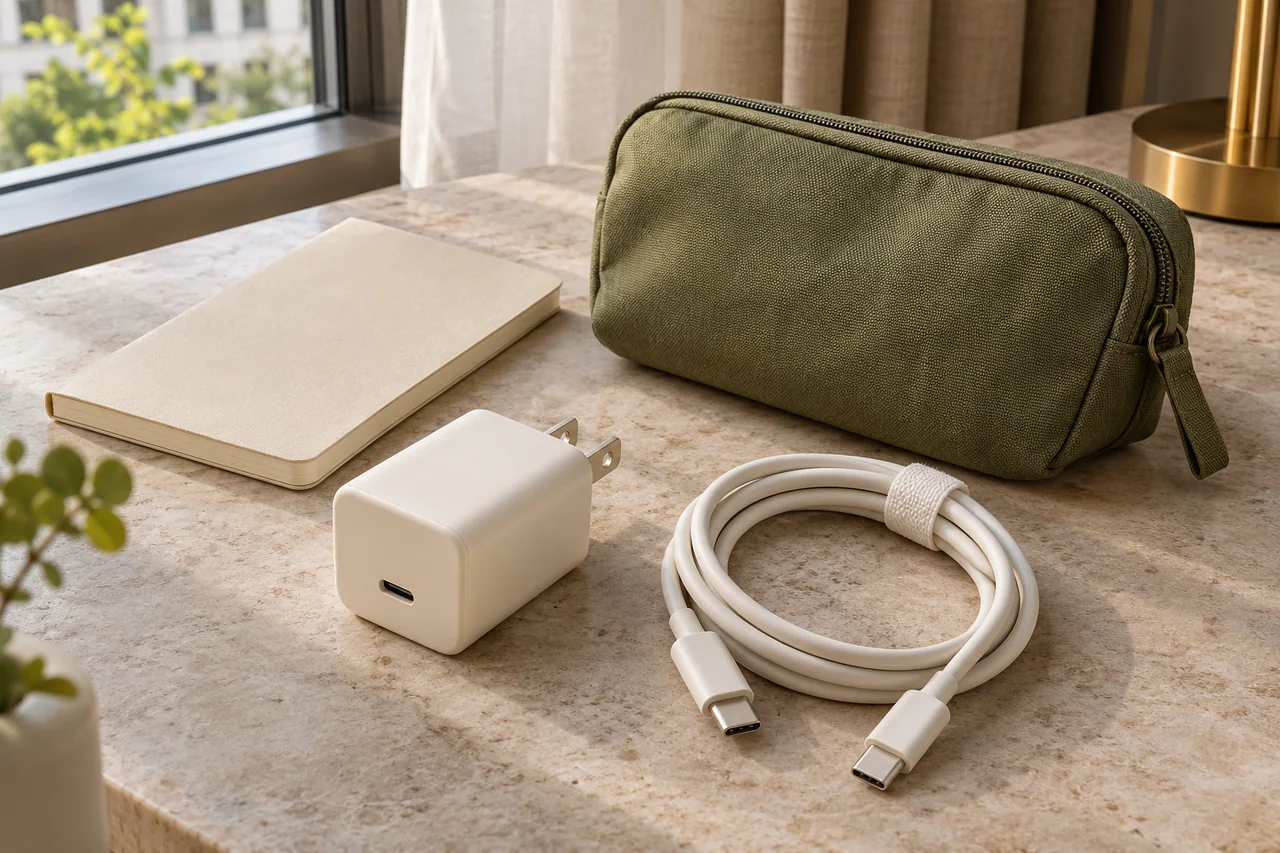
FAA PackSafe and IATA passenger guidance say power banks and other spare lithium batteries must travel in cabin baggage, not checked baggage. This remains important even when a power bank is small. Keep it protected against damage and short circuits, using a suitable pouch or its original packaging where appropriate. Do not let loose metal objects contact exposed terminals.
If airline staff gate-check your cabin bag, take the power bank out before handing over that bag and retain it with you. A swollen, damaged or recalled battery is a different safety problem from a capacity question: do not rely on that item for a trip. Report a battery that becomes abnormally hot, smokes or starts to swell to the crew immediately, and follow their instructions rather than attempting an improvised intervention.
Choose the output for the devices you actually carry
Once the airline rules and Wh rating are clear, check the output requirements of your phone, tablet or laptop. Watt-hours describe stored energy; watts describe the rate at which power can be supplied. A large Wh rating does not prove a power bank supports your laptop's requested USB-C charging mode. Read the manufacturer's port-by-port output table and any cable requirements.
Think about how often you will have a wall outlet on the itinerary. An overnight airport connection may call for a different setup from a short daytime flight. Consider the actual weight, dimensions and number of ports, but avoid treating marketing claims about 'full charges' as measured results. Charging losses, device battery size, temperature and usage all affect what you can achieve.
Make a carrier-specific checklist before departure
Look up the policies of every operating carrier, including a regional or codeshare leg. Note the quantity limit, accepted Wh range, whether advance approval is necessary, permitted onboard use, where the unit must be stored, and what happens if cabin baggage is checked. Check your destination and connection requirements as well; an allowance on one flight does not establish an allowance for the next.
Pack one clearly labeled bank that covers a defined need rather than buying the largest option by default. Save the official manufacturer specifications and carrier guidance somewhere available offline. The practical decision is not 'Which number is biggest?' but 'Which correctly labeled unit fits the devices, baggage arrangement and current policies for this journey?' If any of those facts remains unverified, keep the product on your research list rather than treating it as an approved recommendation.
FURTHER READING
Sources & useful references
These sources support the guide. Rules and product details can change; check the relevant provider before your trip.
- FAA PackSafe — lithium batteries and power banksChecked November 17, 2026
- ICAO — power bank changes effective 27 March 2026Checked November 17, 2026
- IATA — safe travel with lithium batteriesChecked November 17, 2026
Our guides are based on source research and practical comparisons. We identify hands-on testing when it has actually taken place. Some commercial links may earn a commission.
How our recommendations and links work